System comparison / NOTE 02
One cabin. Two trays. Or a continuous loop?
Understand the structural differences between an enclosed dumbwaiter, an open tray lift and a continuous chain tray system for restaurant food service.
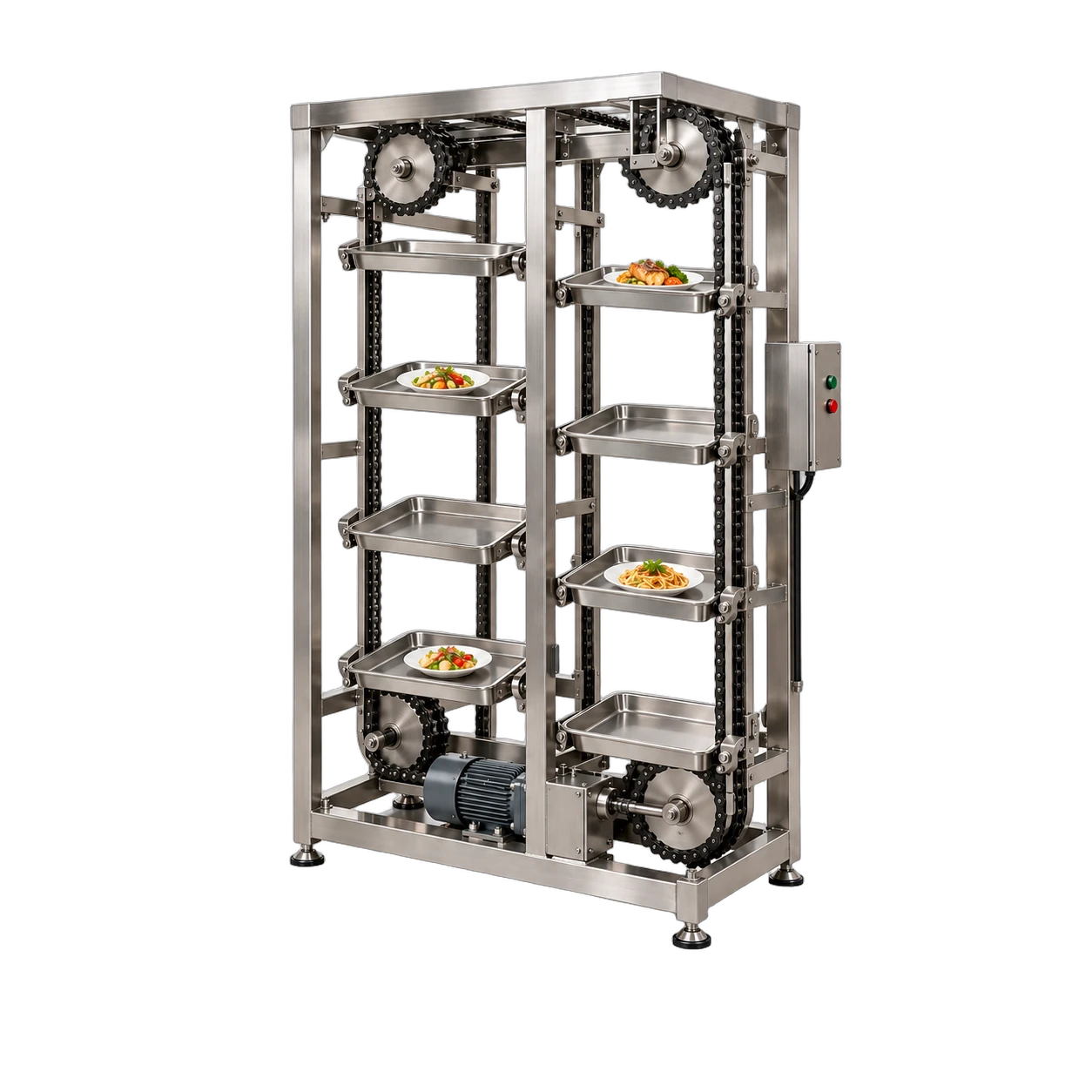
Food lift names can be confusing. The words food lift, kitchen lift and restaurant lift do not always explain what the machine actually does. To compare products usefully, look at what carries the food and how that carrier moves — then check whether that format fits your floors, load, space and budget.
Here are the structural differences between the three formats in our collection.
The short comparison
| Question | Enclosed dumbwaiter | Open tray lift | Continuous chain tray system |
|---|---|---|---|
| Best for | Higher floors and formal restaurant routes | Price-sensitive low-rise kitchens | Very busy kitchens that need continuous flow |
| What carries the dishes? | An enclosed cabin with an internal shelf | Two open trays on one carriage | Multiple individual trays on a chain loop |
| How does it travel? | The cabin travels between stops and returns | The carriage travels between stops and returns | The trays circulate around a closed loop |
| How does the kitchen load it? | Load a cabin, then send it | Load the trays, then send the carriage | Load available trays in sequence |
| Practical capacity | Up to about 300 kg per trip | Up to about 150 kg; lighter dish traffic fits better | About 25 kg / 50 jin per tray |
| Floors | No practical floor-count limit for typical restaurant projects | About four floors or fewer | About four floors or fewer |
| Footprint | Cabin shaft and landings | About 0.5 m × 0.5 m in many projects | Larger loop footprint |
| Reference equipment price | About CNY 6,000–7,000 for a typical 2-stop set, excluding freight | About CNY 4,000–5,000 for a typical 2-stop set, excluding freight | About CNY 22,000–23,000, excluding freight |
| What should be checked early? | Cabin size, load and landing space | Budget, opening size and low-rise travel | Peak rhythm, space and tray load |
Localized site pages convert the CNY reference ranges into the currency that matches the page language. Treat every figure as an equipment reference only. Freight, installation and final configuration still change the quotation.
An enclosed dumbwaiter: one cabin per journey
The enclosed dumbwaiter carries dishes in a cabin with an internal shelf, in the familiar international cabin format. The cabin travels from the loading point to the receiving point, is unloaded and returns to collect the next batch.
That return journey is central to the way the restaurant uses it. The kitchen needs a place to prepare the next load, and the receiving team needs a clear routine for unloading the cabin.
When reviewing this format, start with the dimensions of the dishes or trays, a practical load up to about 300 kg and the available shaft space. Then consider how the cabin can be accessed at each landing.
Choose the cabin format when you need a formal route, higher floors or stronger loads. Each trip still waits for the cabin to return before the next load.
An open tray lift: no cabin, one shared carriage
The open tray lift replaces the enclosed cabin with an open carriage. In this format, two trays are attached to the same carriage and move together. Rails fix to the wall and trays hang on the carriage, so installation stays comparatively simple.
It is useful to be precise about that detail. Two trays do not mean two independent lifts, and they do not form a continuous loop. After delivering and unloading, the carriage returns before the kitchen sends its next load.
The format suits price-sensitive low-rise projects and can fit in roughly half a metre by half a metre. Plan for about four floors or fewer, and treat about 150 kg as a ceiling — day-to-day use is better for plates, bowls and light dishes than for running near the maximum.
Choose the open tray format when budget, tiny footprint and a simple low-rise install matter most. Check guarding and access along with the space available for the equipment.
A continuous chain tray system: many trays, a circulating route
The continuous chain tray system uses a different movement principle. Many individual trays circulate around a chain loop. The trays remain level as they carry dishes between the loading and receiving points.
The kitchen can place a dish on an available tray and use following trays as they arrive. There is no need to wait for one enclosed cabin to complete its return before loading the next available carrier. That is why very busy kitchens look at this format first.
This changes the receiving routine as well. Someone needs to collect dishes at the destination. If a dish is not removed, it continues around the loop on its tray and returns to the loading floor. The team needs a clear procedure for that return.
Plan around about 25 kg, or roughly 50 jin, per tray, about four floors or fewer, and more floor space than a compact tray lift. The higher equipment cost is justified only when continuous handoffs are truly needed.
Choose a continuous system when peak service is relentless and the team can manage both ends of the loop. Review the complete route, loading access and service access before choosing it.
What the product category cannot tell you
Knowing the movement format does not tell you the exact load, travel speed, permitted travel height, power arrangement or installation requirements. Those details belong to a confirmed model and configuration.
The same principle applies to claims about space and efficiency. An open structure may look smaller in a product image, but the real installation also needs clearance, access and appropriate protection. A circulating system offers a different loading rhythm, but useful throughput still depends on how people use it.
Avoid comparing one product’s marketing number with another product’s unspecified configuration. Start with matching assumptions and ask what a figure includes.
Five questions to narrow the choice
- Where is the kitchen, and which floors need to receive dishes?
- What is the actual vertical travel and available installation space?
- Are dishes prepared in batches or handed off in a continuing sequence?
- What are the largest dish dimensions and intended loads?
- Who will load, receive and manage returning dishes?
Add the destination country and any available plans to those answers. They form a useful brief for the next conversation.
Choose the rhythm before the rendering
A cabin, an open carriage and a circulating tray loop solve the vertical handoff in different ways. The useful choice is the one that fits the route, the dishes, the budget and the people receiving them.
Explore all three food lift systems, read the floor plan and selection guide, or start a project enquiry with your building details.