Planning guide / NOTE 01
A food lift starts with your floor plan.
A practical guide to choosing a restaurant food lift: map the serving route, compare the three system formats and prepare the details that matter.
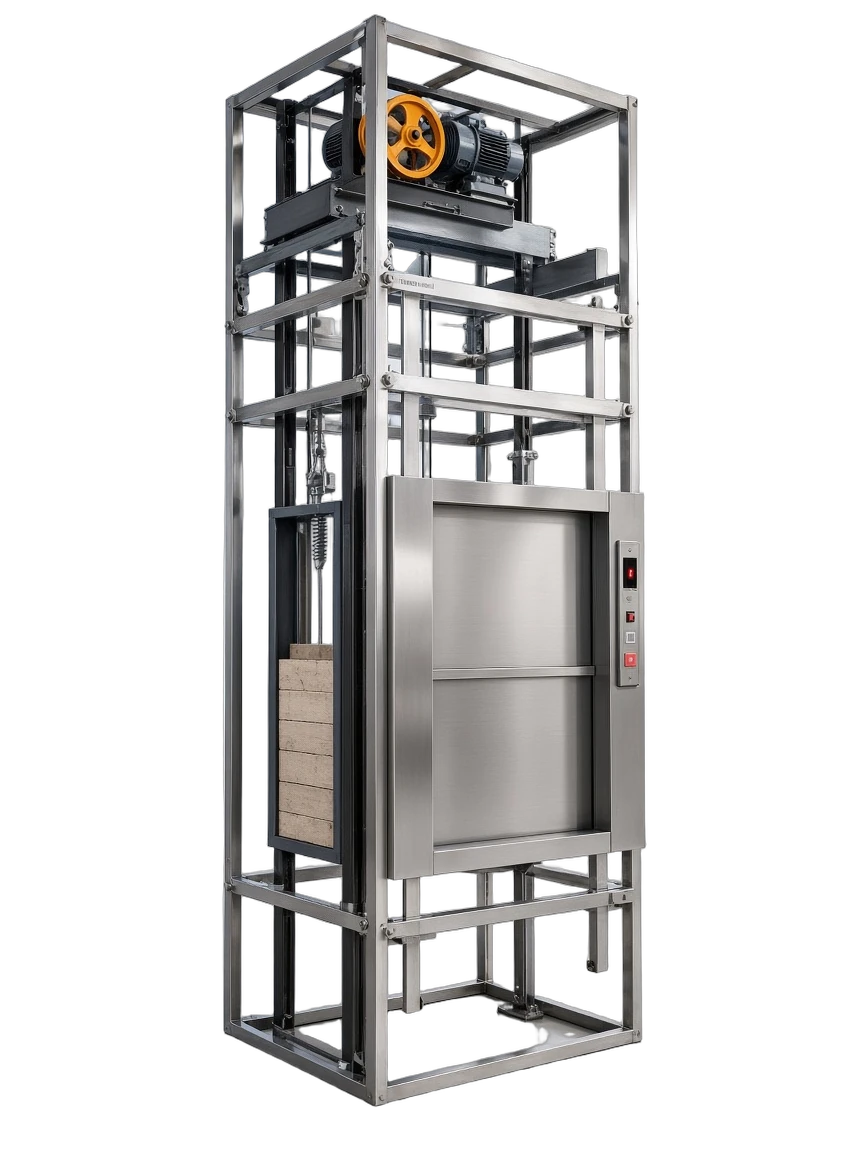
A food lift is part of a restaurant’s serving routine. Before choosing a cabin size or looking at a product image, start with a more useful question: how should a dish travel from the kitchen to the person who serves it?
The answer connects the building, the equipment and the people who use it. This guide explains what to consider before selecting an enclosed dumbwaiter, an open tray lift or a continuous chain tray system.
1. Draw the route a dish actually takes
Mark the kitchen, the loading location and every serving floor on a simple plan. Follow one dish from preparation to the table. Then follow empty dishes or containers back to the kitchen, if that is part of the proposed routine.
Look beyond the vertical journey. A lift that opens into a narrow passage may create a difficult handoff even when it fits within the floor opening. The loading area needs room for the person preparing the delivery, and the receiving point needs room for someone to remove it.
Write down:
- The kitchen and serving floor locations.
- The number of intended stops.
- The distance between the relevant floor levels.
- The available opening or shaft dimensions.
- The direction from which people approach each serving point.
Keep floor count and travel height separate. Two buildings with the same number of floors can have different vertical distances and very different layouts.
2. Understand the three movement formats
An enclosed dumbwaiter carries dishes inside a cabin. The team loads it, sends it to a destination, unloads it and returns it for the next batch. Choose it for higher floors, a formal cabin route and loads up to about 300 kg.
An open tray lift has no enclosed cabin. Two trays share a carriage and move together. The basic loading rhythm is still a return journey: send a load, remove it, then bring the carriage back. Choose it for price-sensitive low-rise kitchens, about four floors or fewer, lighter dish traffic and a very small footprint.
A continuous chain tray system carries multiple individual trays around a loop. The kitchen loads an available tray and can use the following trays in sequence. Staff upstairs remove the dishes as they arrive. A dish that is left on its tray continues around the loop and returns to the loading floor. Choose it when the kitchen is extremely busy and needs continuous handoffs, accepting higher cost, more space and about 25 kg / 50 jin per tray.
These are different structures, rather than three names for the same product. Choosing between them begins with the serving routine, floors, load and budget you actually have.
3. Observe a busy service
Ask the kitchen and serving teams how dishes leave the pass during a busy period. Do they prepare several dishes as a batch? Do dishes arrive one after another? Is there always a person ready to receive them upstairs?
A reciprocating system needs time for a complete load, delivery, unloading and return sequence. A continuous system depends on an organised receiving routine, because trays keep circulating. Neither description alone tells you the useful capacity of a particular installation.
Avoid choosing a system only because a product listing quotes a dishes per hour figure. Meaningful capacity depends on the configuration, the dishes, how they are loaded and how they are received. Bring those details into the discussion before comparing performance claims.
4. Measure what you plan to move
The largest plate is not always the largest item. A tray, a covered dish, a serving bowl or a container may set the practical dimensions. Height matters as well as width and depth.
Prepare measurements for the items the system will actually carry. Include the expected load and whether items are moved individually or grouped together. If different floors serve different purposes, explain that too.
Do not assume that a visual rendering proves a dish will fit. Product images help explain a format. A confirmed configuration needs dimensions and other project information.
5. Consider access and the installation location
An open appearance does not remove the need to plan appropriate guarding and access. An enclosed cabin also needs a suitable shaft, landing arrangement and operating procedure. All three formats need installation and service access to be considered alongside the restaurant layout.
Share the destination country at the start. Local requirements and the building itself can affect the configuration and installation. Treat those requirements as part of product selection, rather than a detail to resolve after ordering.
Food lift equipment is for goods. It must never be used to carry people.
6. Prepare a useful first enquiry
A clear initial brief is more useful than asking for the price of an unspecified lift. You do not need a complete engineering package to begin, but the following details make the conversation more concrete:
| Detail | What to share |
|---|---|
| Location | Destination country and city |
| Building | Number of serving floors and vertical travel |
| Space | Opening or shaft dimensions and landing access |
| Food handling | Largest dishes, trays or containers and expected load |
| Service routine | Batch deliveries or dishes handed off in sequence |
| Supporting material | Floor plans, measurements or photographs of the intended location |
If a measurement is not available, say so. Identifying what still needs to be checked is part of planning a suitable configuration.
Start with the route, then choose the system
The strongest starting point is a clear picture of your kitchen’s work. The building sets the space. The dishes set the handling needs. The serving team sets the rhythm.
Once those are understood, the differences between a cabin, an open tray carriage and a continuous tray loop become much easier to assess.
Plan your food lift with the details you already have, or compare the three systems side by side.