The selection guide
Your space.
Your service.
Your way up.
Start with the way your kitchen works. The right system follows from there.
A useful starting point
What matters
most to you?
Choose a priority to explore a possible fit. Exact selection still depends on your site and the actual model.
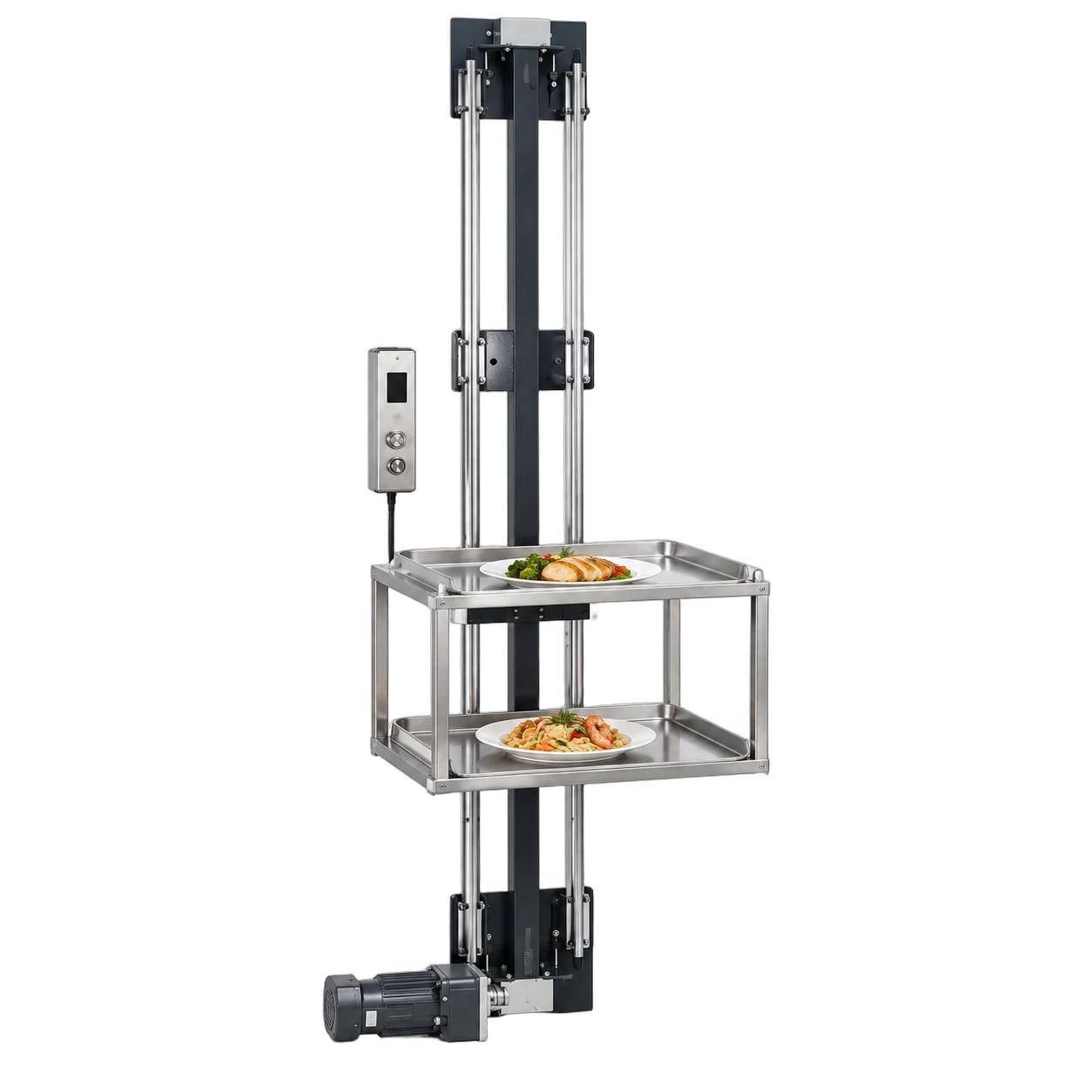
Start with the open tray lift.
A simple two tray carriage is a useful starting point for a compact, low rise project. Confirm the actual model’s footprint, travel and load.
Explore this systemSide by side
The difference
is in the movement.
Three structures. Three ways of handling the journey between floors.
| What to compare | Enclosed dumbwaiter | Open tray lift | Continuous chain lift |
|---|---|---|---|
| What moves | A single enclosed cabin | One carriage with two open trays | Multiple independent level trays |
| The journey | Travels to a landing, unloads and returns | Travels up and down on a guide mast | Circulates around a continuous chain loop |
| Service pattern | Batch movements | Batch movements in a compact setup | Continuing dish movements |
| Start by checking | Cabin size and landing layout | Footprint, travel and tray size | Tray spacing and loading positions |
| Explore the details | View dumbwaiter ↗ | View tray lift ↗ | View chain lift ↗ |
Before choosing a model
Bring the space
into the conversation.
A clear brief is more useful than a guess about capacity.
Build your project brief- 01
The building
Country, project type, served floors and the height between each landing.
- 02
The available space
Clear opening dimensions, landing positions and a sketch of the proposed route.
- 03
The food you move
Dish sizes, load per trip and whether service is occasional or continuous.
- 04
The installation plan
Power supply, site access, installer responsibilities and local requirements.
Your next level starts here
Let’s take your service up.
Tell us about your floors, your space and the way your kitchen works.